 Fruit Leather
A
fruit leather is made by drying a very thin layer of fruit puree or a
mixture of fruit juice concentrate and other ingredients on a flat
surface in an oven, desiccators or in direct sunlight, to obtain a
product with a chewy texture similar to soft leather.
Almost
any type of fruit is suitable for making fruit leathers. Fruit leather
is easy to eat, convenient to pack, and makes an ideal popular snack
almost anywhere for a mouth-watering sugar boost. When dried, the
product is usually pulled from the surface, rolled and consumed. The
control of the drying temperature is very important, as very high
temperatures may cause case hardening, hindering the outflow of water.
Too thin a layer of purée, on the other hand, can make the product
brittle and difficult to be pulled from the surface.
Measuring Firm Paste Texture
Texture
is a very important property of fruit pastes since they are often used
as fillings for energy bars and other products containing fruits.
Among
all textural properties, hardness and stickiness are the most
important, since they can dictate the possibility of application onto a
product. Usually fruit pastes are applied by lightly heated rollers. If
the paste is too hard or sticky it may not be properly applied.
 Fresh
fruits are in many ways ideal snacks, but suffer from difficulties in
distribution and lack of universal seasonal availability.
Convenience,
therefore, dictates that frequently some preparation and preservation
needs to be carried out to ensure their availability throughout the
year, ensure consistency of quality and even enhancement of particular
attributes.
Whilst dried fruits retain a great deal of their nutritive
value they often come under criticism for texture as drying can cause
considerable loss of textural integrity.
Fresh
fruits are in many ways ideal snacks, but suffer from difficulties in
distribution and lack of universal seasonal availability.
Convenience,
therefore, dictates that frequently some preparation and preservation
needs to be carried out to ensure their availability throughout the
year, ensure consistency of quality and even enhancement of particular
attributes.
Whilst dried fruits retain a great deal of their nutritive
value they often come under criticism for texture as drying can cause
considerable loss of textural integrity.
Measuring Detachment Force
Table
grapes are highly perishable, non-climacteric fruits. Their shelf life
is shortened by loss of firmness, berry drop, discoloration of the stem,
desiccation and fungal rots.
The berry drop is due
basically to dry-drop (or abscission) – ethylene in conjunction with
falling auxin levels, induces the formation of an abscission zone at the
pedicel-berry junction, thus stimulating their drop. Grape varieties
susceptible to berry drop present a huge problem for successful storage
and marketing. For this reason it is required to predict and control the
harvested abscission of grape berries, which is not only of inherent
scientific interest, but it also has considerable commercial
significance.
Testing
fruits of non-homogenous nature or variable texture, such as water
melons where there is a high seed content, is not only tricky by any
puncture, shearing or compression method, but often results in low
reproducibility and misleading data.
In any of these tests,
the data may show wide variances between maximum and minimum force
resistance, depending upon whether the probe or fixture meets with less
or more seeds or variable texture when tested. By penetrating the
product in several areas at the same time, the Multiple Puncture Probe
produces an averaging effect and is therefore more representative.
A
compression test may be the preferred test method, but where fruit
samples vary in size this will immediately reflect in the magnitude of
force measured as it is subject to surface area differences and
consequently the reproducibility of results will be poor.
In this instance, the fruit will be required to be prepared into pieces of accurate dimensions – usually cubes or cylinders.
This type of test commonly applies to:
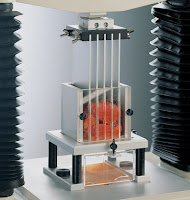 |
| Kramer Shear Cell |
a: Soft fruits: drupelets and berries – e.g. cranberries, blueberries, blackberry, raspberry, strawberry, pomegranate arils, grapes
b: Fibrous samples: such as pomegranates, citrus fruits, pineapples which have been prepared into pieces.
c: Pieces of fruit that have been prepared into smaller pieces e.g. apple cubes.
The primary issue of these types of samples is that they are usually of varying sizes or are of non-homogeneous nature and therefore make comparisons difficult. They therefore have a high variability from piece to piece within the same batch and require a large sample set to be tested. Puncture or compression tests to rupture are possible but usually produce results with poor repeatability.
 Fruit can alternatively undergo a mild non-destructive test where the deformation response of a large cylinder probe or platen is measured to effectively mimic the compression between one’s fingers.
However this has the problem of measurement variability due to differing contact area with the fruit surface which varies because of irregularities in fruit shape and size and results may then be compromised for the convenience of using such a test.

 Fruit Leather


