Tuesday, 15 January 2019

Fruit Texture: How to measure firm pastes and dried fruit flakes


Measuring Firm Paste Texture 

Texture is a very important property of fruit pastes since they are often used as fillings for energy bars and other products containing fruits.

Among all textural properties, hardness and stickiness are the most important, since they can dictate the possibility of application onto a product. Usually fruit pastes are applied by lightly heated rollers. If the paste is too hard or sticky it may not be properly applied.

Tuesday, 8 January 2019

Fruit Texture: How to measure toughness and stickiness of dried fruit

Fresh fruits are in many ways ideal snacks, but suffer from difficulties in distribution and lack of universal seasonal availability.

Convenience, therefore, dictates that frequently some preparation and preservation needs to be carried out to ensure their availability throughout the year, ensure consistency of quality and even enhancement of particular attributes. 

Whilst dried fruits retain a great deal of their nutritive value they often come under criticism for texture as drying can cause considerable loss of textural integrity.

Tuesday, 18 December 2018

Fruit Texture: How to measure detachment and deseeding force

Farmer picking grapes

Measuring Detachment Force

Table grapes are highly perishable, non-climacteric fruits. Their shelf life is shortened by loss of firmness, berry drop, discoloration of the stem, desiccation and fungal rots.

The berry drop is due basically to dry-drop (or abscission) – ethylene in conjunction with falling auxin levels, induces the formation of an abscission zone at the pedicel-berry junction, thus stimulating their drop. Grape varieties susceptible to berry drop present a huge problem for successful storage and marketing. For this reason it is required to predict and control the harvested abscission of grape berries, which is not only of inherent scientific interest, but it also has considerable commercial significance.

Tuesday, 11 December 2018

Fruit Texture: How to measure flesh firmness of non-homogeneous fruits


Multiple puncture test on melon
Testing fruits of non-homogenous nature or variable texture, such as water melons where there is a high seed content, is not only tricky by any puncture, shearing or compression method, but often results in low reproducibility and misleading data.

In any of these tests, the data may show wide variances between maximum and minimum force resistance, depending upon whether the probe or fixture meets with less or more seeds or variable texture when tested. By penetrating the product in several areas at the same time, the Multiple Puncture Probe produces an averaging effect and is therefore more representative.

Tuesday, 4 December 2018

Fruit Texture: How to measure flesh firmness of prepared homogeneous fruit samples


Mango cube
A compression test may be the preferred test method, but where fruit samples vary in size this will immediately reflect in the magnitude of force measured as it is subject to surface area differences and consequently the reproducibility of results will be poor.

In this instance, the fruit will be required to be prepared into pieces of accurate dimensions – usually cubes or cylinders.

Tuesday, 27 November 2018

Fruit Texture: How to measure the overall firmness of a weight or quantity of fruits

This type of test commonly applies to:
Kramer Shear Cell
Kramer Shear Cell

a: Soft fruits: drupelets and berries – e.g. cranberries, blueberries, blackberry, raspberry, strawberry, pomegranate arils, grapes

b: Fibrous samples: such as pomegranates, citrus fruits, pineapples which have been prepared into pieces.
c: Pieces of fruit that have been prepared into smaller pieces e.g. apple cubes.

The primary issue of these types of samples is that they are usually of varying sizes or are of non-homogeneous nature and therefore make comparisons difficult. They therefore have a high variability from piece to piece within the same batch and require a large sample set to be tested. Puncture or compression tests to rupture are possible but usually produce results with poor repeatability.

Tuesday, 20 November 2018

Fruit Texture: How to measure the firmness of whole fruit by compression

Lady eating appleFruit can alternatively undergo a mild non-destructive test where the deformation response of a large cylinder probe or platen is measured to effectively mimic the compression between one’s fingers.

However this has the problem of measurement variability due to differing contact area with the fruit surface which varies because of irregularities in fruit shape and size and results may then be compromised for the convenience of using such a test.


Tuesday, 13 November 2018

Fruit Texture: How to assess skin strength and flesh firmness of whole fruits

Penetration test of avocado sample
Penetration test of avocado
sample using a P/3 Cylinder
Probe and the Circular Support
The measurement of firmness is of paramount importance to know the proper maturity and ripening stage during growth and storage of fruit.

Firmness can be an indicator of immaturity or overmaturity. Excessive peach firmness, for example, can indicate an immature peach with little free juice. Conversely, an overmature, soft peach can be excessively juicy and prone to bruises.


Where individual fruits are to be tested, penetration testing (using a cylinder or ball probe smaller than the fruit) provides a constant surface area for testing which often reduces the variability of results when compared to compression testing data.


Measuring the skin strength and flesh firmness of whole fruit


A penetration test destructively measures firmness by registering the force required for a Cylinder Probe (generally from 2mm – 8mm in diameter), Magness-Taylor Puncture Probe, or Ball Probe, to penetrate the fruit’s flesh to a chosen distance and is frequently used for testing firmness of a wide variety of fruits. Magness-Taylor probes are commonly used, widely accepted in the field of testing of whole fruit and have historically been the reference measure for firmness in many fruits as this method has shown good correlation with consumer acceptability for firmness. With probes of this size and shape the skin will yield once penetrated and the underlying flesh can also be measured.

Penetration testing has the benefit of not requiring samples to be of the same size and does not require sample preparation. However, orientation of the penetration is important as samples of this nature are anisotropic. The depth of penetration varies according to the fruit size and proximity to e.g. pits, cores and it is sometimes possible to perform tests on both sides of each fruit tested e.g. peaches. Some larger berries are commonly penetrated using a small (e.g. 2-3mm) Cylinder Probe and the maximum force taken as the firmness value. 


Penetration test of apple using a Needle Probe
Penetration test of apple
using a Needle Probe
For ease of testing, the fruit is often cut in half and the fruit laid down onto the sample platform cut surface down in order to stabilise the sample for penetration testing of its side. This method may be the only testing option if there is limited availability of sample to test but repeatability may be compromised. To obtain reliable results and reduced variation in this way, special attention should be paid to aspects of size, ripening stage and growing conditions.

This type of test primarily assesses skin strength/toughness and elasticity, yield point and resilience, the ripening and softening profile and the firmness of the underlying flesh. Some researchers prefer to remove a small section of the skin/peel with a razor blade so that penetration can be performed on the flesh only and the test is isolated to the measurement of flesh firmness.


A Penetration Test of Whole Fruit can be applied to:
a: Fruit with pits: where the outer skin covers a soft, fleshy fruit and the fruit surrounds a single, hard stone, or pit, which contains the seed – cherries, apricots, nectarines, peaches, plums, avocado, olives
b: Fruit with cores: where there is a central seed-containing core surrounded by a thick layer of flesh – apples, pears
c: Large fruits without cores: melons – large, juicy fruits with thick skins and many seeds

d: Citrus fruits where a measure of the peel characteristics are required: these possess a thick outer rind and a thin membrane separates the flesh into segments – e.g. oranges, tangerines, grapefruits, kumquats, lemons, limes

e: Starchy fruits: banana – pasty homogeneous starchy fruits with very soft texture; easily mashed to pulp or follow viscous behaviour when squashed

f: Large berries
g: Tropical fruits – papaya, figs, dates, guavas, mangoes, kiwis.


Interpretation of Whole Fruit Penetration Curve
The firmness of ripe and unripe samples can be tested by penetrating a small diameter cylinder probe into the whole fruit (around the equatorial region) and measuring the subsequent force to rupture the skin and further penetrate through the underlying tissue to a chosen distance of e.g. 5mm.

Curves of ripe vs. unripe pears
1: Curves of ripe vs. unripe pears
tested using a 2mm cylinder probe
The probe proceeds to move down onto the fruit and an initial rapid rise in force is observed. During this stage the sample is deforming under the applied force but there is no puncturing of the tissues.

This stage ends abruptly when the probe punctures through the skin and begins to penetrate into the sample flesh, which event is represented by the sudden change in slope called the “yield point” (or “bioyield point”). The yield point (maximum force) occurs when the probe begins to penetrate into the food, causing irreversible damage.

The third phase of the puncture test, namely the plateau of the force after the yield point, is an indication of the underlying flesh firmness of the fruit (1).


2: Penetration force/distance curve
and parameters
Six texture parameters can be calculated from the force-displacement curve (2). The maximum force (Fmax) represents the force required to puncture the fruit skin. Fmax represents the skin strength as is often termed the bioyield point. The probe displacement Dp, expressed in mm, is the value of the probe position at Fmax and indicates the elasticity of the skin.

Stiffness, is the slope of the first part of the curve measured from the beginning of the curve to Fmax. Work of penetration (W1) is the mechanical work needed to reach the rupture point, as is taken as the area under the curve to Fmax. Flesh firmness (Ff) is the average value of the forces measured after skin rupture. W2 is the work measured (area under the curve) after the skin rupture. 


These values can be automatically calculated with the use of a simple macro within Exponent software, making collection of parameters quick and intelligent.

Watch the video below
to see a summary of the types of testing possibilities that are available for the measurement of fruit and vegetable texture to provide quality control tools and ultimately, consumer satisfaction:


View fruit and vegetable video


For more information on how to measure texture, please visit the Texture Analysis Properties section on our website.

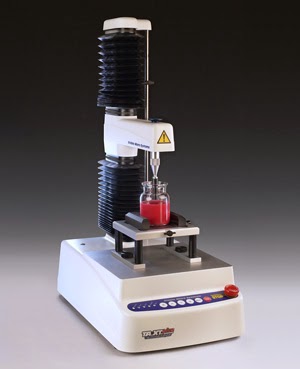
TA.XTplus texture analyser with bloom jar The
TA.XTplus texture analyser is part of a family of texture analysis instruments and equipment from Stable Micro Systems. An extensive portfolio of specialist attachments is available to measure and analyse the textural properties of a huge range of food products. Our technical experts can also custom design instrument fixtures according to individual specifications.

No-one understands texture analysis like we do!

To discuss your specific test requirements, click here...

 Fruit and Vegetable testing videoDownload a published article covering methods for the testing of fruit and vegetables

Browse our range of fruit and vegetable testing solutions